now a brief history of what we now call the internet. the first computer networks began to emerge in the 1950s, epescially in government agencies and universities. these network connected computer terminals with direct, dedicated lines (even over great distances), allowing for intra-netting. by the early 1960s, national security concerns and the desire to allow researchers in different geographical locations to share resources and ideas created the need for inter-netting. J.C.R. Licklider theorizes on the idea of an 'Intergalactic Network' where people can access data and programs on one computer from any other computer anywhere else in the world (or galaxy...he was quite the visionary). The early internet pioneers faced two key challenges: how to efficently move data and how to overcome the lack of standardization among computer hardware and software used on each individual network.
Paul Baran, Donald Davies, Leonard Kleinrock address how to move data. They develop the notion of packet switching. When data is sent from one computer to another, it is broken into small packets of information which are routed from the source to the destination computer through various nodes. If one of these packets is lost in transmisison, it can simply resent from the source, and therefor the entire transmission is not lost. becuase a didicated line is not required for the duration of the transmission, packets from diffenent sources bound for different destinations can be sent across the same communication line, which maximizes bandwidth. packet switching also allow for complete decentralization of the internet. it is plausable that each packet in a transmission could take a different route to the destination. also, as the architecture of the internet changes, data can still move through it without reinfrastructing.
the first internet was the ARPANET developed and managed by ARPA (advanded research projects agency), an agency of the u.s. department of defense. ARPANET went live in 1969 and had four nodes: ucla, us santa barba, university of utah, and the stanford research institutue.
the following is the map of arpanet in 1971:

and then the ARPANET in 1980:

increases in technology and demand for internetting caused the internet to continue to grow. various other networks were created and integrated. standards were implemented to allow these various networks to interconnect. in 1990, the ARPANET was disbanded as it had been rendered obsolete by other networks.
the growth of the internet (charts show the number of internet hosts):

today, there are 1,086 billion users connected to the internet. this represents roughly 16.7% of the worlds population.
a map of the interet (just in north america):

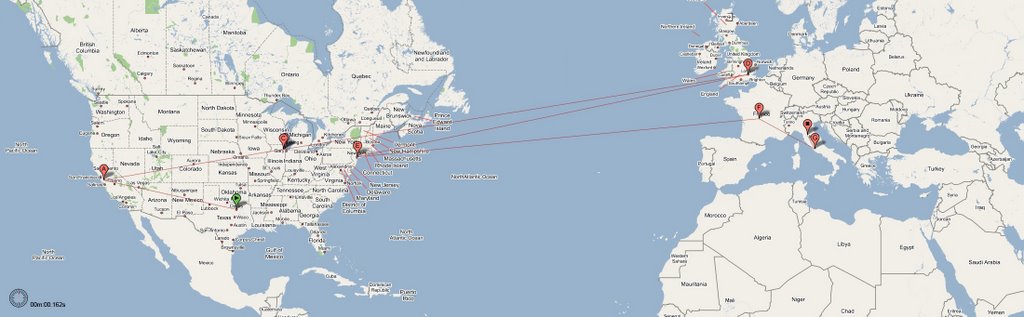
as we all know and experience daily, the internet allows for information to be exchanged at a blinding rate. rarely, however, do we consider the geographic movement of our data transfers as them move through the internet. below is a map that traces the path of data from dallas texas to tuscany, italy (generated by traceroute). it represent the shortest path between the two points at the time of the trace.
below is the same route by traditional means of travel:
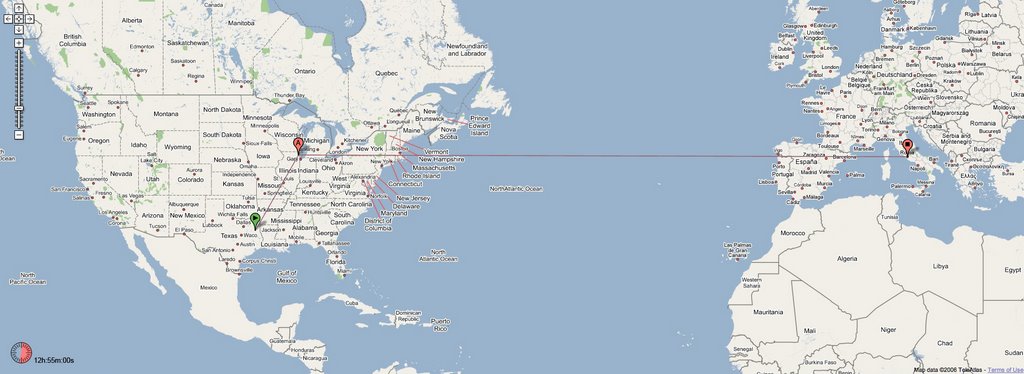
air travel
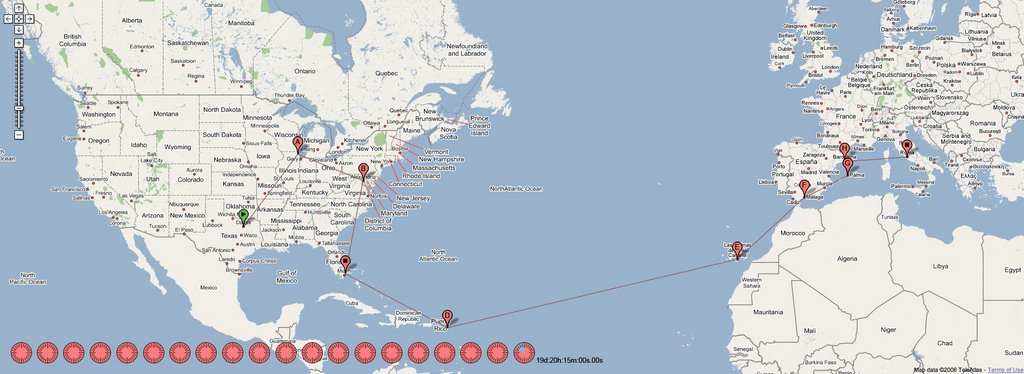
land + sea
some great links:
internet history
internet maps


7 comments:
aha! i see you already have made a post ready for mega blog. you may try to get your hands on the book Else/Where: Mapping that i have in the recommended book section of MEGARAEL. it will help with your mappimations i think.
I am able to make link exchange with HIGH pr pages on related keywords like [url=http://www.usainstantpayday.com]bad credit loans[/url] and other financial keywords.
My web page is www.usainstantpayday.com
If your page is important contact me.
please only good pages, wih PR>2 and related to financial keywords
Thanks
jamliweeclife
[url=http://www.officialfalconsnflshop.com/]Matt Ryan Jersey[/url]
They kept right on thanking Him The Haloid Company for the first time in 1949 developed electrography for commercial use The effects of the mistakes he makes in his ministry does not reflect back in his life alone but it is suffered at an exponential magnitude in the lives of the people he is ministering to Death is a human or physical concept and in truth you do not have to leave your physical body behind
[url=http://www.navorrobowmanjersey.com/]NaVorro Bowman Nike Jersey[/url]
It could be anything: a small ball, bone, stick, meat wrappingIn fact, exactly how much RAM your laptop can hold may in part drive your purchase decisionThink about this statement by Norman MacEwan: "Happiness is not so much in having as sharing They make a Jiu Jitsu Competitor Tank Top and Vale Tudo Attack Tank Top that are made of 100% soft cotton and the sizes range from small through 2XL
[url=http://www.andrewluckjerseys.us/]Andrew Luck Nike Jersey[/url]
dcprybdly 163 yvglbhdiu http://www.chaussures-louboutin-france.com ccqmvgybb 078 qbpjlpixm [url=http://www.chaussures-louboutin-france.com]Louboutin Pas Cher[/url] tgnibkaai 771 plcpnnfjv
oaabddlud 570 usuqwrzqt http://www.chaussureschristianlouboutinfr.net lhlxosfls 851 ceswwbfdg [url=http://www.chaussureschristianlouboutinfr.net]Louboutin Pas Cher[/url] qeraswexj 249 xanusgzgk
fvtdirugw 086 cwlghobqo http://www.acheterchristianlouboutinpascher.net qadwdntjy 374 yupjfuhpc [url=http://www.acheterchristianlouboutinpascher.net]Louboutin[/url] autlxejsg 973 otkgefqod
nytlkjvip 199 hdesdipmt http://www.acheterchristianlouboutinpascher.com qdjbmrwhg 162 pryobuuqc [url=http://www.acheterchristianlouboutinpascher.com]Louboutin Chaussures Homme[/url] sbwgtfovs 289 yqdprmqzr
kepmtecso 151 krokcrume http://www.chaussureslouboutin-france.com yonzkortv 849 vmenksoyv [url=http://www.chaussureslouboutin-france.com]Louboutin France[/url] rbrigpybk 794 xakxrlugp
If you wish for to improve your experience only
keep visiting this web page and be updated with the newest news update posted here.
my web page: Zahngold Preis
Hello. And Bye.
522278 [b]Tag:[url=http://www.cheapraybanaviators1853.org/]cheap ray ban sunglasses[/url],[url=http://www.cheapraybanwayfarers1853.org/]oakley sunglasses discount[/url],[url=http://www.oakleydiscountoutlet.org/]discount oakley sunglasses[/url],[url=http://www.oakleydiscountsunglass2013.org/]discount oakley sunglasses[/url];Links:[/b][url=http://www.facebook.com/]cheap ray ban[/url]
Rayban sunglasses, plus they are thought to be another kind of traditional function amongst all of the shades.Perhaps the actual continuous development as well as stand out would be the solution to have an worldwide manufacturer to savor a good itinerant existence.After that this is a issue which choosing doctor prescribed shades. Like a issue associated with truth each kind associated with doctor prescribed shades offers their very own particular functions. For instance, health professional prescribed sun glasses which in turn incorporate your popular features of the two health professional prescribed cups along with sun glasses. These are specially suitable for those people myopia whom should be out-of-doors generally. That they get rid of the constraint that will eyeglass has on ought to don disposable lenses while they need to don sun glasses. Rayban grasps ebay option. Many major analysts troubled usually are termed in exploration the condition of which the way to make a style of eye protection which will provide wearers a particular imaginative and prescient vision in addition to eyes safeguard. Soon after 3 years' working hard, recommended eyeglasses which unfortunately unite any attributes of together recommended glasses or contact lenses together with eyeglasses. They're just mainly manufactured for the ones myopia what person has to be open air regularly. These eliminate the limit the fact that eyeglass wear really need to dress in contacts anytime they might be dress in eyeglasses. medication solar shades which inturn join that why people love each of those medication eye glasses and even solar shades. They are really notably specifically for the myopia just who needs to be exterior commonly. Some people get rid of the cap which will eyeglass will wear be required to be dressed in lenses once they will be dressed in solar shades. therefore that users would most likely go through a great sensing,
Post a Comment